

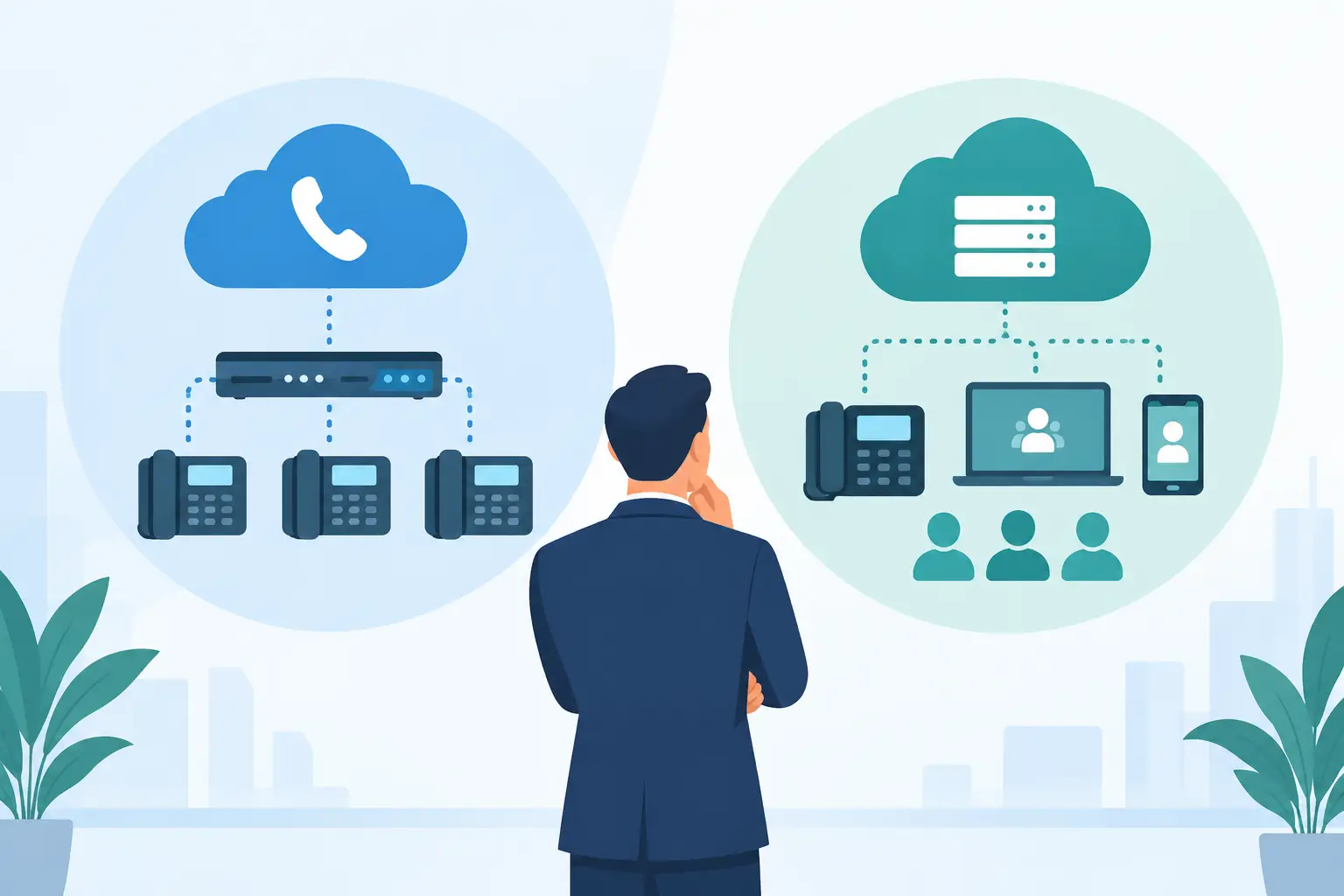
A missed call can mean a missed customer, delayed approval, or a project that stalls while staff try to reach the right person. For Miami and South Florida businesses evaluating SIP trunking vs hosted PBX, the real decision is not about phone-system terminology. It is about where your communications system lives, who manages it, and how confidently your team can rely on it when business is moving fast.
Both options use internet-based calling. Both can support professional features such as auto attendants, voicemail, call forwarding, mobile access, and direct dialing. But they divide responsibility very differently. One places more control in your organization’s hands. The other shifts more of the infrastructure and day-to-day administration to a provider.
SIP Trunking vs Hosted PBX: The Core Difference
SIP trunking connects an existing or customer-managed phone system, known as a PBX, to the public telephone network through an internet connection. Instead of installing traditional phone lines, the business uses Session Initiation Protocol, or SIP, to carry calls over IP.
Hosted PBX is a cloud-based phone system managed primarily by a service provider. The PBX software and calling infrastructure reside offsite, and users connect through desk phones, softphones, or mobile apps. The provider typically handles the platform, feature updates, capacity, and much of the maintenance.
These terms are often presented as direct alternatives, but there is a technical overlap: a hosted PBX may use SIP technology behind the scenes. The practical difference is ownership and management. With SIP trunking, you usually retain or deploy the PBX. With a hosted PBX, you consume the phone system as a managed service.
When SIP Trunking Makes Sense
SIP trunking is often a strong fit for organizations that already have a capable on-premises PBX or a specific need to retain control over their voice environment. A business with a substantial investment in phone hardware, custom call flows, specialized integrations, or a large office may not want to replace its existing system simply to move calls to the cloud.
It can also provide flexibility in how calling capacity is purchased. Traditional phone service commonly requires a fixed number of physical lines. SIP trunks allow organizations to scale concurrent call capacity more efficiently. A busy medical office, property management group, or multi-department operation can add capacity as call volume changes without installing additional legacy circuits.
The trade-off is that more responsibility stays with the business. The PBX, local network, firewall configuration, Quality of Service settings, power protection, software maintenance, and failover planning all need active attention. If the PBX fails or the office loses internet connectivity without a backup plan, voice service can be affected.
SIP trunking works best when the organization has internal IT expertise or a trusted managed technology partner prepared to take ownership of the entire voice environment. The savings can be meaningful, but only when the underlying infrastructure is properly designed and supported.
SIP Trunking Is Often Best for Businesses That Need
Organizations may lean toward SIP trunking when they have an existing PBX worth keeping, require deep customization, operate from a primary office with dependable connectivity, or need to integrate phones with equipment and business applications already in place. It is particularly useful when control matters more than removing infrastructure from the building.
When Hosted PBX Is the Better Fit
Hosted PBX is designed for businesses that want reliable business communications without maintaining phone-system servers onsite. The provider hosts the core system, while employees use IP desk phones, computers, and mobile devices to place and receive calls.
For a small or mid-sized business, this model removes a significant technical burden. There is no local PBX server to patch, no voice gateway to maintain, and no need to size equipment for future growth years in advance. Adding a new employee, changing an extension, updating call routing, or opening a remote workspace is generally simpler than it would be with a traditional onsite system.
Hosted PBX also supports the way many teams now work. An employee can answer their business line from a desk phone in the office, a softphone on a laptop, or a mobile application while visiting a client. Properly configured, callers reach the right person without needing to know where that person is working that day.
That convenience does not eliminate the need for sound network planning. Hosted calling still depends on internet quality, adequate bandwidth, properly configured network equipment, and a clear continuity plan. A cloud phone platform cannot compensate for an overloaded office connection or poorly managed WiFi.
Hosted PBX Is Often Best for Businesses That Want
Hosted PBX is a practical choice for teams that want predictable monthly costs, less onsite equipment, easier support for remote staff, and a single provider accountable for the phone platform. It can be especially effective for businesses opening new locations, replacing an aging phone system, or operating without a dedicated internal IT department.
Comparing Cost, Control, and Reliability
The lowest monthly price is not always the lowest operational cost. SIP trunking may appear less expensive if a business already owns its PBX and has staff who can manage it. However, the total cost should also include server replacement, licensing, maintenance, configuration work, security oversight, backup connectivity, and the cost of downtime if something fails.
Hosted PBX generally uses a per-user or per-seat monthly model. That can make budgeting more straightforward, especially for organizations with fluctuating headcount or multiple locations. The business avoids a large upfront PBX purchase, although phones, implementation, network improvements, and specialized integrations can still create one-time costs.
Control follows a similar pattern. SIP trunking provides more direct control over the PBX, dial plans, integrations, and system behavior. That is valuable for organizations with complex requirements, but it also means more administrative responsibility. Hosted PBX reduces that burden, though some providers may offer less flexibility for highly customized workflows.
Reliability depends less on whether the system is cloud-based and more on how thoroughly it is engineered. A dependable design should account for business-grade internet service, network prioritization for voice traffic, battery backup for critical equipment, redundant connections where downtime is costly, and automatic call forwarding during an outage. A phone system is only as reliable as the connectivity and support behind it.
Questions to Ask Before Choosing
Start with the system you have today. If your current PBX is modern, stable, and tightly connected to business operations, SIP trunking may extend its value. If the system is aging, difficult to support, or limiting remote work, hosted PBX may offer a cleaner path forward.
Next, consider call patterns. Do you have high call volume at specific times? Do employees work across multiple locations? Do customers need to reach departments through structured menus and queues? Do you rely on integrations with CRM, scheduling, security, or paging systems? The answers will shape the right architecture.
Finally, be honest about support ownership. A phone system cannot be treated as an appliance that only matters when something breaks. It needs monitoring, updates, security controls, documentation, and someone who can respond quickly when callers cannot get through. For many businesses, the best option is the one with clear accountability from implementation through ongoing support.
Build the Phone System Around Your Operations
The right choice between SIP trunking and hosted PBX should make communication easier for staff and more dependable for customers. It should also fit your network, budget, growth plans, and tolerance for managing technical infrastructure internally.
CompuSOURCE helps South Florida organizations assess those operational needs, design the supporting network, and maintain the technology behind business communications. Before replacing phones or signing a contract, take time to map how calls move through your business. A well-planned decision now can prevent missed calls, frustrated employees, and costly disruptions later.
Comments are closed